

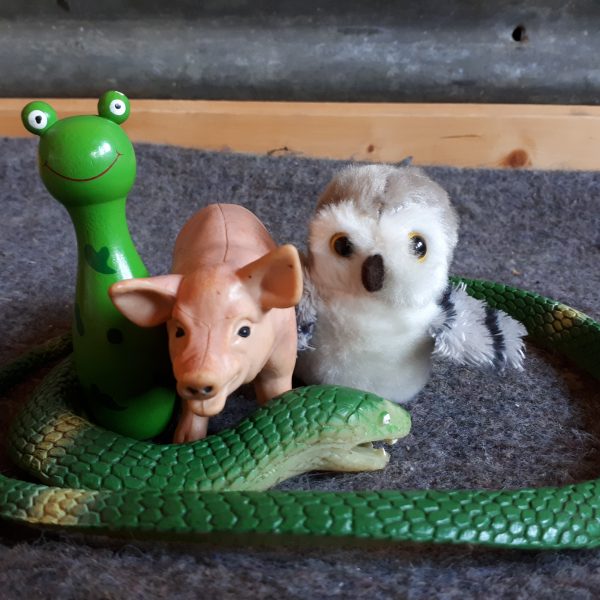
The lovely chatty Willow class from Astley CE School came to the farm today to learn about animal classification. We started the day thinking about different animals and their characteristics. I lined up all my animal toys and we could see similarities and differences. The toys were split into mammals, amphibians, reptiles and birds. I also put out some feathers and had ‘buzz’ my stuffed Buzzard to show the children.
On the farm walk the children looked at the wild bird mix we have planted to feed to birds and small mammals on the farm. We then went pond dipping. I couldn’t believe how many minibeasts the children found. The children were very lucky to see dragon flies flying above the plants in the pond. The dragon flies were very brown in colour and smaller than the emerald green ones I see in the summer. A girl presented me with a mini beast I hadn’t seen before, which turned out to be beetle larvae. The pond yields different creatures in the Autumn.
In the play wood the Year 2 children remembered their ‘fairy tales’ trip to the farm last year and re-enacted Billy Goats Gruff on the big climbing logs.

All of Year 2 from St Andrews CE School came out to the farm this week. Our topic was fur, feathers and fins with Autumn and habitats mixed in. After the health and safety talk, the children told me about their topic and were very animated when they told me about salmon. I became even more animated, as I have been fortunate enough to see salmon and bears in Alaska which I told the children about.
I showed the children a selection of feathers I have found on the farm and later on the farm walk the children collected their own feathers. I also showed the children a stuffed buzzard which most (!) of the children were fascinated by.
After snack the children went on a nature collection walk and at the end of the walk the children used their nature items to make habitats for some rubber ducks. The diversity of leaves, feathers, seeds and flowers was amazing. Autumn is a great time for a farm trip. As the weather was so good, one group even managed to do some pond dipping.
Later on in the play wood, a couple of children carried on with the topic, picking up feathers and birds feet (!) left from the buzzards kill.
The lovely ‘Cats’ class from Cropthorne-with-Charlton CE First school came to the farm today. Our topic today was about ‘harvest’ from the farm. We started the morning discussing the different foods which are sourced from dairy cows and at lunchtime the children were offered samples of red, green and blue topped milk. Green was the most preferred. Our discussion moved on from dairy cows to Autumn and the children told me the things they expected to see on the farm in September.
At the start of our farm walk, we looked at the wheat grains in the farm shed, ready to feed the calves in the morning. We thought about why we didn’t see any yellow wheat plants out in the fields and why the yellow straw is so useful.
We then split into five teams. Each team had a bucket and were challenged to fill the bucket with lots of items from nature. The children were fantastic at finding interesting leaf shapes, grass heads, hedgerow berries and acorns. In the orchard we looked at the fruit trees and found different sized and varying colours of apples and pears. The children enjoyed picking the almost black ‘Worcester Black’ pears.
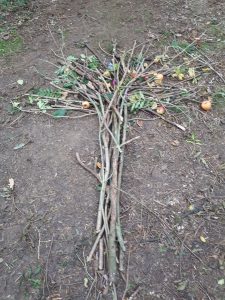
After lunch the five teams were challenged to use the materials in the play wood and the contents of their buckets to make a picture of a tree. The results were fantastic and a really good activity for the children and the competitive adults!

Today Year 2 from Sedgeberrow C of E First School came out to the farm and their topic was Islands. I started the morning asking the children to tell me about Islands, they described blue seas, yellow sand and coconut trees. I then asked them to name a food they eat. We then discussed whether the food they had named could be produced on our island. We discovered that many of the foods we eat can be sourced from the UK.
I then showed them a world map and pointed out the island of Iceland. We could see that it was surrounded by sea and close to the largest island Greenland and the North Pole. In groups, the children looked at an annotated map of Iceland. They learnt that in olden times the people living on Iceland had to largely rely on the food the island provided, which included beef and dairy cows, sheep, fish, whales, sharks, reindeer and even puffins. These foods are still consumed today as it is very expensive to transport food to Iceland.
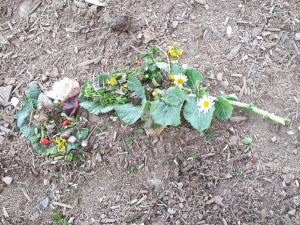
We then talked about the seasons and we went on an Autumnal nature hunt. The children, each with a bag, collected an amazing array of flowers, seeds, feathers, berries and leaves. At the end of the farm walk we went into the cow shed and the children were asked to use the collected items to create a picture of something to do with Iceland. The children showed great imagination as they made pictures of waterfalls, artic foxes, volcanoes, seals and a hot water outdoor swimming pool.
Over lunch the children tried Skyr yoghurt, an Icelandic staple.
During the time in the play wood, a few of the children enjoyed finding cones which had fallen off the tree and those cones which had been nibbled by squirrels and other small mammals.
A waterfall
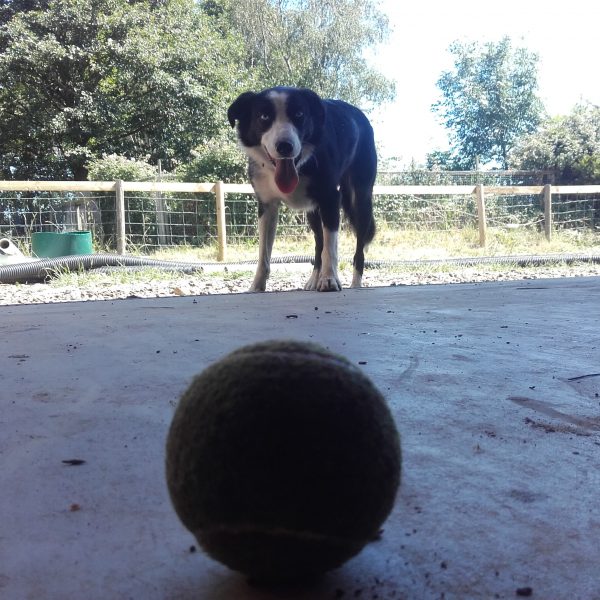
What a wonderful day I have had with the very lovely children, staff and parent helpers from Holy Apostles school in Cheltenham. The children were brilliant from the moment they stepped off the coach. Fly Dog had a fantastic day too playing ball with the children even though it is very hot!
Our topic today was Into The Wild which meant we considered farm animals and crops and wild animals and plants. The children told me the names of farm animals and then they thought of lots of animals which may live on my farm. Later on we went pond dipping to find out which wild creatures live in the pond. On our way back for lunch we looked at some badger poo!
The children also walked through a wheat field and picked an ear of wheat to see if it was ripe enough for harvesting. Today the flour inside the wheat seeds is more of a white cream than a powder. The children also learnt that farmers like some wild plants around the edge of their fields, so that the ladybirds and beetles can have a home by the wheat and eat the naughty aphids.
The children learnt that the wild plants in the pond and the wild life area by the pond, were all put there by nature.
After lunch the children went into the shade of the playwood and had a great time finding mud, whilst I continued building the new mud kitchen.
You must be logged in to post a comment.